
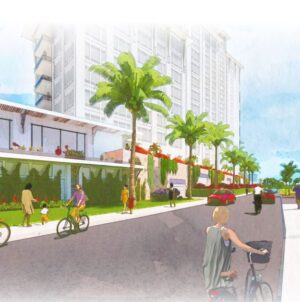
Seagate’s plan to redevelop the 52-acre former Red Coconut property with 5 buildings, including two 17-story structures could now be delayed as a court challenge to the town’s approval of the process has officially been filed.
Dan and Jane Riddle, Michael Dagnese, Constance Spataro, Evert and Sussane Jelsma, Mary Tuttle, Paul and Gail Jasionowski and Nathaniel Gorham are listed as petitioners on the filing. They all live within 500 feet of the proposed Seagate project.
In April, following a recommendation to deny from the LPA, and by a 3-2 vote, the Fort Myers Beach Town Council approved the Seagate project. Mayor Dan Allers and Councilman Scott Safford voted no. At the second of two public hearings on the project, the majority of public comment from the community was in opposition, with by far the number one objection being the height of the buildings. Fort Myers Beach was incorporated in the mid-90’s because Lee County was approving tall buildings and residents, at that time, wanted to put a stop to it.
Following the vote to approve, a community group called Protect FMB was formed with a goal of raising $100,000 to pay the law firm of Hahn and Loeser to fight the town for approving the project. According to their Facebook page $35,000 has been raised so far and another $10,000 is needed by March 15th to keep the fight going. Seagate is not a party in the filing. It’s the neighbors against the town.
The Seagate plan includes two condo towers that could be as high as 17 stories. They are asking for buildings that are over 200 feet higher (235 feet total) than what’s allowed by right. The plan includes 137 condo units, 4 single family homes, a restaurant open to the public, a 240 foot view corridor on the beach side of the property, a private pedestrian walkover and a private beach club with availability of local paid memberships.
In their filing, the neighbors argue that the Fort Myers Beach Town Council’s approval of Seagate’s development agreement application was not supported by competent substantial evidence, that the application departed from the essential requirements of the law and it deprived residents who opposed the project due process. In essence what they are saying is the Town Council did not follow the rules set forth in their own Land Development Code.
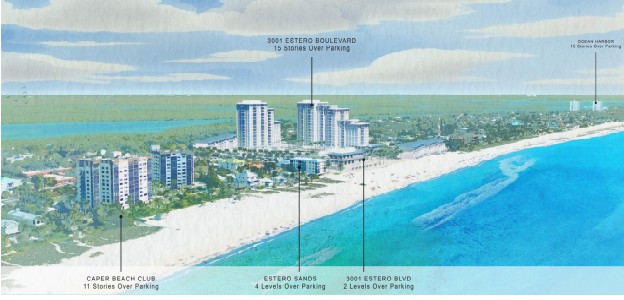
One of the arguments from the neighbors was the claim by Seagate that the Red Coconut property was in an area that included other tall structures. From the filing: “The Red Coconut property is not so surrounded by tall buildings…that the height regulations in this chapter [30 feet above base flood elevation] would be unreasonable. All the buildings that are “contiguous to” (or across the street from) the Red Coconut Property are, at most, two stories above base flood elevation. The nearest high-rise development, Caper Beach Club, a pair of 12 story condominium towers, is located approximately half a mile from the Red Coconut Property. The other referenced high-rise, Ocean Harbor Condominiums, is approximately 1.4 miles to the South. The absurdity of Seagate’s requested height deviation is further demonstrated by its own project rendering, which depicts two massive condominium towers (both 255 feet tall) that tower over the Fort Myers Beach horizon. The Town and Seagate either (at best) misread and misunderstood this condition precedent, but more likely, intentionally ignored the requirement Seagate must meet to seek relief as to building height.”
 In another part of the filing the neighbors object to the amount of public benefit the town received for approving such a big and tall development. Both LPA and Town Council members admit the Land Development Code is vague when it comes to public benefit and public benefit is subjective. One member of the LPA may think a view to the beach is most important while a member of the Town Council may think a park is the top priority. There is no system that states if you give the town X, you will get 5 more stories of height in return. It’s all subjective bargaining between the developer and whoever happens to be on council at the time.
Here are the original 10 public benefits Seagate said it was providing to the town. Some may have been modified during back-and-forth negotiations with the town.
1) Two view corridors to the Gulf of Mexico from Estero Boulevard;
2) 1 view corridor to Matanzas Pass Preserve;
3) Enhancements to existing private beach access;
4) Incorporating new public beach access with a gulf side public park;
5) A new public park adjacent to Matanzas Pass Preserve;
6) A new public park adjacent to the bay side of Estero Boulevard;
7) A new public linear park interconnecting Estero and Donora Boulevards through the Property;
8) Establishing the first portion of an east/west local street from Donora Boulevard to Lovers Lane;
9) Enhancing the street frontage of Estero Boulevard;
10) Parking in excess of LDC requirements for the multi-family structure and single family units.
The filing also took a shot at Vice Mayor Jim Atterholt for considering the comments of former Red Coconut owner Fran Meyer who spoke out in favor of Seagate’s proposal and said the development would result in less density than her RV park. The filing referred to Myers’ testimony as unqualified. From the filing: “There is no competent, substantial evidence in the record to support Ms. Myers’ density claims. Indeed, Ms. Myers’ claim that the density under Seagate’s proposal would be “one-third” less than the Red Coconut RV Park that existed pre-Hurricane Ian is mathematically improbable. The maximum density on the Red Coconut Property was “27 RV/mobile homes per acre.” LDC Section 34-692(3)(a)(8). Seagate’s proposed redevelopment would reduce that number to 15 dwelling units per acre (55% of the “27 RV/mobile homes per acre” pre-existing density limit).”
The filing also took a swipe at Council member John King for mentioning LPA member Jim Dunlap discussing the additional financial stability the new project would bring to the beach. The neighbors say King’s bias deprived them of due process and his decision to support Seagate was not based on competent substantial evidence. From the filing: “Council Member King’s prejudgment of Seagate’s Proposed Development Agreement was not based on any competent, substantial evidence, but rather unsubstantiated opinions and speculation regarding the Town’s “financial sustainability” and the economic benefits that Seagate’s project could bring.”
Prior to the Town Council voting to approve the project, Town Attorney Nancy Stuparich said the council was on solid legal ground if they decided to approve the project. The town will have to respond to the filing when the court issues an Order to Show Cause. At that point we will know what the deadline is for the town to respond.
We reached out to Seagate CEO Matt Price by email for comment on the filing. He said on the advice of his attorney there would be no comment at this time. Price has said that from approval date of the ordinance final design phase will take up to a year. He said the Beach Club on the Gulf side would be built first and act as a sales center for the condo units. He said with 2 towers being built it enables Seagate to move forward without as many pre-sales of the condo units if there was only one tower. If the Margaritaville court challenge is any indication, Price’s projected time-frame will most likely face delays.
If you would like a copy of the 60-page filing send an e-mail to edryan@beachtalkradio.com.
Local journalism is hard work. If you appreciate the most in-depth reporting on Fort Myers Beach, please support what we do HERE by Venmo, Zell or PayPal. Thank you.
Comments are closed.