
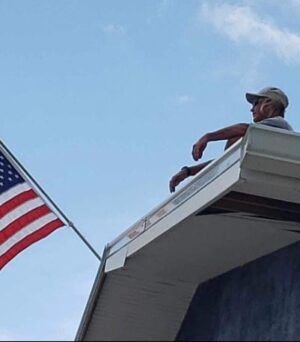
By now the entire island knows that Rick Loughery is camped out in protest on top of his garage roof at 5137 Estero Boulevard. Rick wired a safe structure to sit and lay on and he only ventures down to use the rest room. During the day he adds an umbrella to his new digs to block the scorching hot August sun.
Rick and Amy Loughery lost their home in Hurricane Ian. Their garage survived because it was built to code in 2019. Now, they’re being told it may have to come down.
The issue has to do with whether the garage and home were attached when Hurricane Ian destroyed the home. On that topic there is much disagreement. The town believes the previous permits show that the garage was attached to the home. The Loughery’s believe the permits show that the garage was a standalone building.
The town has determined that the Loughery garage was built as a connected addition to their home. The town states that “The garage was not connected via a covered breezeway, it was shown on the reviewed plans and photographs as being connected to the main residence.” And once the determination is made by the town that the garage was part of the house, FEMA’s 50% rule applies to the garage as part of the house.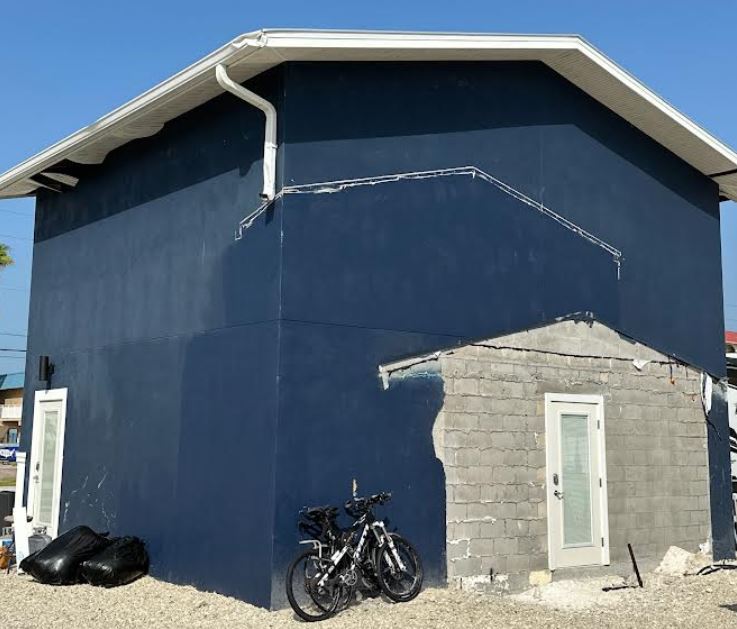
Amy and Rick have been arguing that their new garage was never attached to the house. That it was a standalone structure, there was no common wall, and should not be subject, as their house was, which is now gone, to the 50% FEMA build-back rules.
Kara Stewart, who worked for the town for over a decade, has been helping the Loughery’s. She’s asked the town and Florida Department of Emergency Management Floodplain Manager Conn Cole to explain how they came to the conclusion that the garage was an addition to the house. “We’re explaining the structure is free standing with it’s own independent foundation, wall system, roof structure. It was cosmetically made to look as though it was attached.”
This is an e-mail response Cole sent to Stewart, “I am not sure how I can be more clear. The surviving garage was not a detached garage or, as you keep referring to, a freestanding structure. It was constructed and permitted as a lateral addition and was connected to the home.”
Amy Loughery met with Fort Myers Beach Building Official Steve Poposki and Town Manager Andy Hyatt Thursday to try to resolve the issue but the meeting ended in a stalemate.
Here are the three options the state has given Amy and Rick after Town of Fort Myers Beach Building Official Steve Poposki ruled the house was attached to the garage.
1. Because the garage portion of the home survived the storm, the home is a substantially damaged structure. The home’s rebuilding must be built to current regulations, and the surviving garage portion must be brought up to current standards (Coastal A Zone, FBC 8th Ed).
2. Convert the surviving garage into a stand-alone accessory structure (storage and parking only) and build a new home. The home would be treated as new construction, and the garage must be brought up to current accessory structure standards (Coastal A Zone, FBC 8th Ed, flood ordinance).
3. Demolish the surviving garage and rebuild a new home with a new garage as new construction, meeting current regulations.
Conn also made it clear that the town cannot simply look the other way. “Should the Town choose to disregard the floodplain management regulations in its ordinance and the flood provisions of the Florida Building Code, the Town’s good standing in the NFIP and CRS could be jeopardized. FEMA is aware of several “high profile” properties and is watching closely to see if the Town brings them into compliance. It would be unfortunate if this property were added to their list.”
Conn did not specify what those other “high profile” properties were that they were spying on.
Common Sense has left the area … Keep up the fight Rick 👍
FMB town council and Gov DeSantis are a disgrace for allowing this kind of BS to go on. We are 10 months into this and Desantis is galavanting around the country like a fool and town council is MIA. Dan the mayor never gives a straight answer. He really doesn’t know. We need Mayor Anita back again. NO ONE but Beach Talk Radio tries to help us. Ed is our voice.
Beach Talk Radio should sell shirts to spread the word
“Rick on the Roof”
And give the proceeds to Rick so he can hire a lawyer. I know Rick is not poor and doesn’t need T shirt money but it is all about sending a message to the Town and FEMA. We all stand with Rick. Let’s get this to go National.
Beware ! The communist are among us.
My opinion: We live on a barrier island. It’s essentially a sandbar. It is highly susceptible to major hurricanes and storm surge – as we just witnessed. Property owners should not be eligible for mortgages and/or subsidized flood insurance. This is a highly risky area to build a home.
If we except that, and forego the subsidized government money, then we can just do what we want. No more red tape, no more FEMA. Barrier islands should not have subsidized government flood insurance. And if that’s what you want – move way inland to high ground that is not susceptible to hurricanes/storm surge and get your mortgage and free market insurance. This answer is simple – if you can just think logically.
Say what? I fail to see the logic in any of your statement and you should have the courage to sign your real name and take responsibility for your opinions.
Absolutely! The government is at the core of the issue. People struggle with this because they’ve been trained to depend on the government. Your suggestion is far more sensible than people realize.
That would require mortgage companies to drop the mandate for flood and hurricane insurance.
The city hall is absolutely ridiculous. They riding around in golf carts and checking what people are doing to their homes and finding them. They need to stop worrying about what people are doing as most didn’t have insurance as they’ve been there many years and we’re in flood zones. They are just trying to get some normalcy back while the city hall still looks like Ian hit last week. They need to worry about them and the stores that are literally falling apart on the main road. The church next to them as well. Huge eye sore. Clean it up or tear it down.
Insurance and the state. Re-read the article if you dont understand that. Its not as simple as clear everything an wait to rebuild
It is obvious from the pictures it is a stand alone garage.
I disagree, the photo sure looks like it was attached, with 2 roof lines and no stucco or paint around the door.
Or, were you being sarcastic? The coffee hasn’t quite kicked in yet.
It appears to have been built butted up against the original home…not attached. Attached would share the same roof, same walls, same foundation. And it would have torn apart with the original. It is in fact, standing alone!
It starts with the garage permit in 2019, should be a simple online look up if the town requirement to build the garage requirements was to not cost more than 50% of the existing value of the house.
If it’s not on the permit it’s not included in the 50/50 rule.
I wouldn’t characterize FDEM/FEMA as “spying on” those other properties.
It’s a LOT of bureaucracy and “red tape” for the Town of FMB to meet the requirements to be eligible for flood insurance/NFIP, and the discounts obtained for high levels of compliance.
Were FMB to lose eligibility for flood insurance, that would have enormous consequences. Even losing its rating that allows the discounts would impact every property on the island.
Other than that “spying” characterization, EXCELLENT article and AWESOME explanation of the facts of this not-straightforward case.
BTR needs more “coffees.” ❤️
Spying is exactly what they are doing.
It’s completely ridiculous the extent they are going to to STOP residents from rebuilding
Permit to replace stones/rocks in your yard/garden?!
Come on man!!!! 🤬🤬🤬🤬
The town is broke and will look for ways to permit/fine you in an attempt to not go bankrupt and have the county take over. Their hands are tied by the federal government. It’s a bad situation for the island. I’m of the belief if you own your property outright and choose to not insure it, you should have the right to build it as you see fit. After it’s all said and done, the cost of insurance premiums -vs- what they actually pay you for recovery it might cost less to pay for repairs and not the insurance.
Comments are closed.