

Vice Mayor Jim Atterholt tried to convince his colleagues to sell the land the old town hall once occupied to help replenish the town’s depleted emergency funds but three members of the Town Council would have none of it and moved to raise the millage rate. Councilman John King joined Atterholt in opposition of a higher rate.
By a vote of 3-2 the Fort Myers Beach Town Council voted to set the tentative 2025 millage rate at $1.03 per $1,000 of assessed property value. The current rate is .99. The taxpayers of Fort Myers Beach were already going to pay more in taxes after Lee County Property Appraiser Matt Caldwell announced property values on Fort Myers Beach increased by 40% since last year. That will result in the Fort Myers Beach budget increasing by $1 million in 2025. Caldwell also said on Beach Talk Radio Saturday, June 15th that by next year property values could be back to where they were pre-Ian which would bring another round of new revenue to the town budget. For three members of this Town Council that just wasn’t enough.
In addition to Caldwell’s rosie predictions for property values on Fort Myers Beach, State Representatives Adam Botana and Spencer Roach both reiterated the state would most certainly be there for Fort Myers Beach if they faced another catastrophic event. Mayor Allers has been saying that through his conversations with members of the state delegation (although he did not specify who) the state expects to see the town also “help themselves.” And, apparently that help has to come in the form of a tax increase.
As the town now goes through the budget process the Town Council can only decide to lower the millage rate. They can not go higher than the tentative rate of $1.03 when they approve their final budget. The Town Council must have a tentative millage rate set by August 4th. Being that there are no meetings in July, the Town Council needed to set the tentative millage rate at Monday’s meeting.

Earlier this month Town Finance Director Joe Onzick told the Town Council that the town’s emergency funds are depleted and they should consider raising the millage rate to start to replenish that fund. In the first two months after Hurricane Ian, before insurance money and FEMA funds arrived to help operate the town, $3.5 million from emergency funds was spent.
If the tax rate stayed at .99, $290,000 would have been deposited back into the town’s emergency fund. Every point the Town Council might raise taxes, another $36,000 is added to that $290,000. Onzick recommended the town raise the millage rate to $1.03 of $1,000 of assessed property value which would net the emergency fund $434,172 in the next fiscal year. Still well short of the $3.5 million he wants in that fund.
Onzick presented the Town Council with only one option to fix the shortfall in the emergency fund…raising taxes. The town has been on a hiring spree as of late, adding a new Harbormaster at a salary/benefits of $93,000 and a new planner at a salary/benefits of $143,000. Onzick did not raise any emergency fund red flags at any public meetings about the spending side of the government when these hires were made.
Now that the state budget has been approved and the town will be receiving a $15.6 million grant, Vice Mayor Jim Atterholt suggested the town sell the old town hall property and replenish the emergency funds completely to where Onzick wants it to be. That piece of land was recently appraised for $13 million. Allers, Woodson and Safford all shot down that idea and want to retain the land. Councilman John King said, “raising the millage rate sends a bad message to our residents. I will not be supporting any increase.”
We asked Greg Scasny who’s running for Town Council this November what his thoughts are on the proposed tax increase. “While not the final millage rate, the willingness of several council members to raise the maximum possible millage rate without taking a serious look at what we need to cut from the budget, sends a message to our community. How can we expect families to come to the island and have the community we all so cherish when there is a never-ending plethora of costs and tax increases? I want my friends and neighbors to rebuild and get back on the island, but increasing taxes is not going to make that any easier. Our town needs to take a very hard look at all our expenditures and assets and get back to the “Government Lite” model our Town was founded on, so we can keep the community that we all love and cherish. I would have voted no.”
Mayor Dan Allers did challenge the town staff to come back with any possible spending cuts that could be made during the budget process.
Allers, Atterholt and Safford are all up for reelection this November.
The town has 3 emergency funds in the budget: Emergency Fund Reserves, General Fund Emergency Reserves and General Fund Operating Reserves. In those 3 reserve funds as of today there is $1.88 million. Based on the history of dealing with Hurricane Ian, Onzick wants that number back up to $3.5 million as quickly as possible.
While Onzick stated a fact that the town quickly spent $3.5 million in the immediate aftermath of the storm, what has not been mentioned at all was that the money was spent by an unprepared government and Town Manager. They had no history of how to deal with a category 5 Hurricane and were disorganized from the get-go. That’s no longer the case. The current Town Council, Town Manager Andy Hyatt and his staff all now understand how to deal with a catastrophic event. They understand who to call about hiring the right debris removal company. They understand they need a hotel off island to communicate with the residents. They understand who to ask for help from the day after the storm. They’ve been practicing their plan to get residents back on the island in a non-chaotic way. Would $3.5 million have to be spent again knowing what the town now knows about how to deal with a major weather event?
To help get over the Hurricane Ian hump the town received an $11.9 million bridge loan from the state. For now, that loan (not all of it has been used) needs to be paid back. While it’s due date is June 30th, it’s likely the state will give the town at least a 6-month extension, maybe even a 10-year extension. The interest rate on the loan is 10%. There is also occasional chatter that the loan may be forgiven down the road. It appears there are restrictions on what money can be used to pay back the bridge loan. Onzick said ad valorem tax money cannot be used.
$8 million of the $15 million grant the town will receive from the state for fiscal 2025 is earmarked for a new Town Hall. $7.6 million is for revenue replacement. The town will be purchasing the building at 6231 Estero Boulevard for $7 million and convert it to a town hall. Now with the $8 million coming from the state (that does not need to be paid back), the town can close the deal on that building and be operating there by January of 2025. A much faster time frame than trying to build a new town hall from scratch. Town Manager Andy Hyatt said building a new town hall from scratch would have cost $25 million and taken up to 3 years.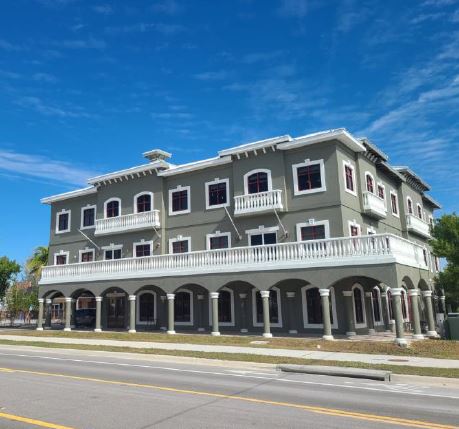
The 3-floor 24,000 square foot building sits at the corner of Estero Boulevard and Bahia Via. It’s a storm-hardened structure, having survived the two most recent hurricanes, including Ian. The building would need only minor alterations before the town would move in. FEMA would have paid for a new Town Hall but they only build back what was previously there. The 6231 Estero Building is bigger than the previous Town Hall.
The Town Council also wants to hear feedback from the residents about the millage rate. If you send an e-mail to this address all five Town Council members will receive it. council@fmbgov.com
Comments are closed.